Virtual care remuneration policy and postdischarge follow-up trends
D’Arienzo D, Mahant S, Austin PC, Yoshida-Montezuma Y, Guttmann A. JAMA Netw Open. 2026; 9(6): e2620021.
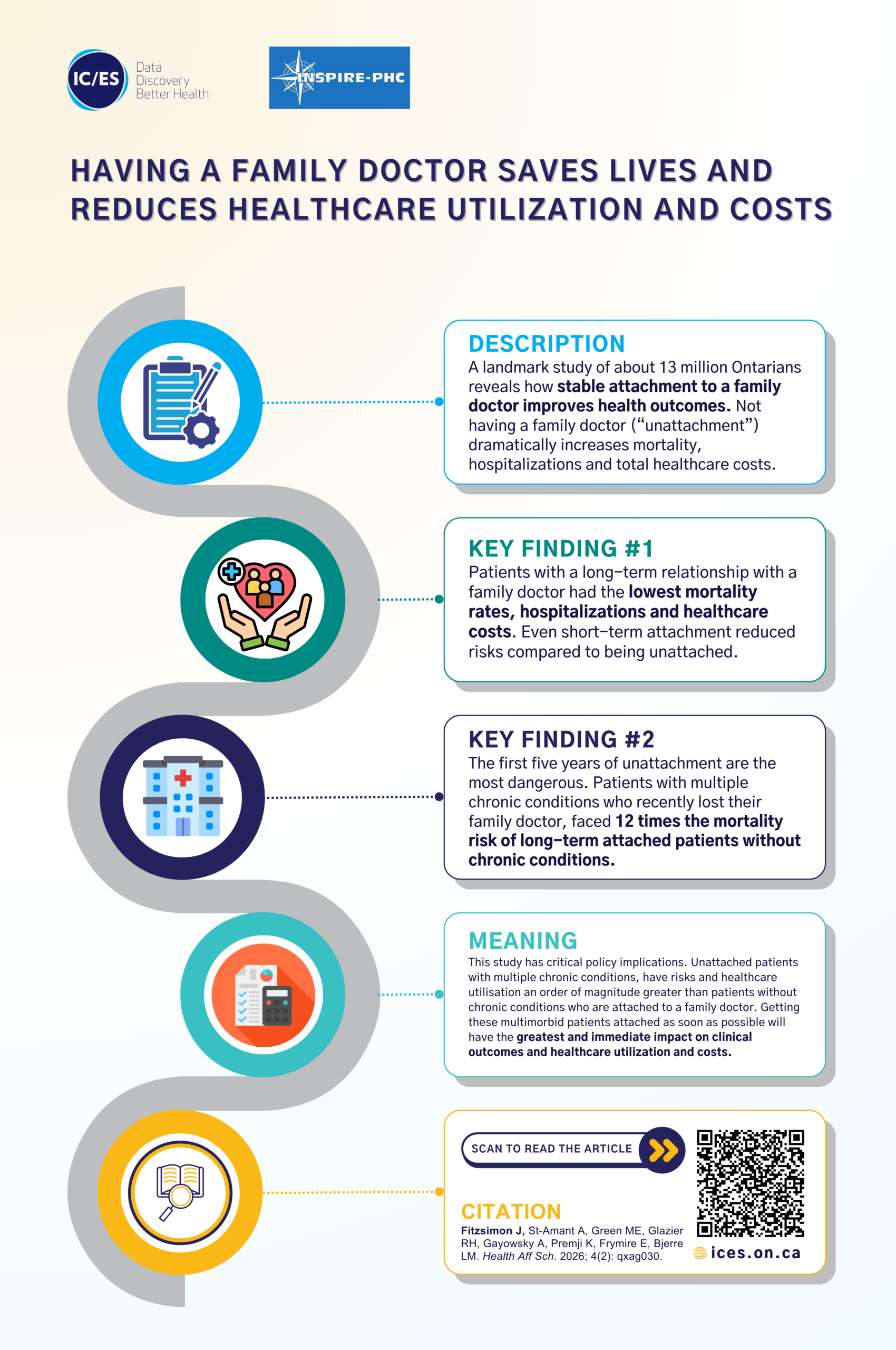
Introduction — Primary care attachment is the formal or informal affiliation with a regular primary care clinician. In countries with near-universal primary care, a physician’s retirement typically results in the transition of care to another doctor. In many low- and middle-income countries, as well as the United States and Canada, this seamless transition often does not exist. A period of unattachment follows, during which the individual lacks primary care.
Methods — This population-based retrospective cohort study of 12 726 325 Ontarians uses health administrative data to examine how the duration of attachment and unattachment influences mortality, healthcare costs, and hospitalizations.
Results — A period of increased vulnerability was observed within the first 5 years of unattachment, associated with 85% higher odds of all-cause mortality compared with those attached for 15+ years. This association was amplified among multimorbid patients. Relative to long-term attached individuals without comorbidity, multimorbid patients exhibited approximately 5-fold higher all-cause mortality when stably attached, increasing to roughly 12-fold among those recently unattached. Cost and hospitalization outcomes exhibited similar patterns.
Conclusion — These findings carry crucial policy implications, underscoring the need for strategies that promote stable attachment, particularly for individuals with multimorbidity, and better patient support following the loss of a primary care physician.
Fitzsimon J, St-Amant A, Green ME, Glazier RH, Gayowsky A, Premji K, Frymire E, Bjerre LM. Health Aff Sch. 2026; 4(2): qxag030.
The ICES website uses cookies. If that’s okay with you, keep on browsing, or learn more about our Privacy Policy.
