
Go to content
  • Home
  • About ICES

Artificial Intelligence at ICES

ICES uses artificial intelligence (AI) to support our research and analytic activities with scientific insights informing clinical and policy decisions to improve people’s lives.

Overview

AI includes information technology systems that can perform tasks that typically require human intelligence. For example, AI can be used to automate tasks, analyze large amounts of data and complex data, and problem solve based on the information that people input into the technology.

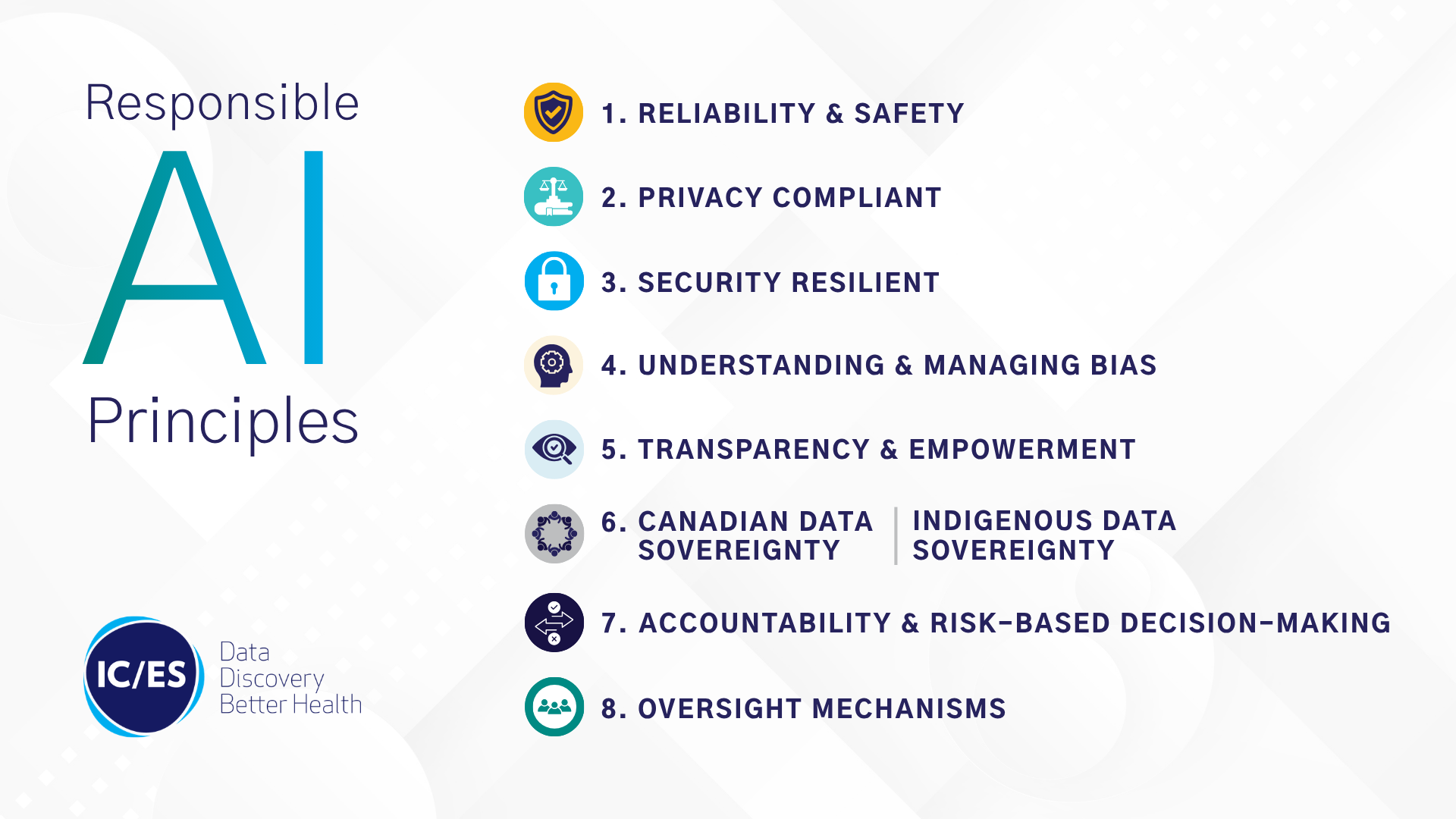
ICES adopted eight principles for ethical and responsible AI use.

AI Activities should not endanger human life and health, and should continue to provide ICES a social license to utilize data for the benefit and improvement of health and health outcomes. This includes measuring how ICES’ AI Activities may impact natural resources, the environment, and communities.

AI Activities should not compromise ICES’ designation under legislation and its reputation as a trusted data steward (avoiding unlawful collection, use, disclosure, retention, and destruction). The dignity of the person should be preserved when ICES Data or Corporate Information are leveraged for AI Activities.

Any data utilized to train AI models should be protected from leaks or disclosures, and AI Systems should be resistant to compromise and attacks

AI Activities should aim to understand and manage biases in data based on demographics and other factors to ensure the AI Activities will equitably benefit all persons. Efforts to manage risks should account for these biases, recognizing and acknowledging that these cannot guarantee equity and fairness.

When ICES Data and Corporate Information is utilized for AI Activities, appropriate information, conveyed in a manner that takes into account the digital literacy of the person, should be enabled and shared with the public.

AI Activities at ICES should align with Canadian data sovereignty to ensure any ICES Data and Corporate Information used in AI Systems remains primarily subject to Canadian law. ICES also respects the principle of Indigenous Data Sovereignty and aims to incorporate the principle in ICES’ approach to data governance and AI Activities that impact Indigenous Data.

There should be clear responsibility assigned for AI Activities such that any risks identified have assigned owners who are accountable for mitigating such risks.

AI Activities should be monitored during and after deployment to align with the principles set out in the Responsible AI Framework, the Responsible AI Policy, and other associated policies, standards, and procedures.

Responsible AI Governance

ICES’ Responsible AI Governance is a roadmap for safe, rules-based, and effective use of AI in ICES’ day-to-day operations and scientific activities. Our governance will be grounded in our commitment to scientific excellence, data stewardship, and public trust.

We recognize our approach to AI will evolve as we learn from our experiences, listen to our community, and respond to changes in AI technology.

Privacy and Security in AI

Privacy and security are essential at ICES. When using AI, we are committed to having rules and practices that ensure data are protected and used responsibly. Visit our Data Privacy and Security page to learn more about how we protect the privacy, security, and confidentiality of data about Ontarians.

Questions? Please reach out to [email protected].

AI in Research

At times, research and analytics conducted at ICES may consider the use of AI in health care and/or integrate AI methodologies within studies, such as using AI to analyze large and complex data sets. ICES and its affiliated researchers carefully review all AI-generated outputs to ensure high standards of quality and accuracy.

Click the tiles below to explore more about AI and healthcare research at ICES.