Cold-related illness among older adults experiencing homelessness
Hoang PM, Kokorelias K, Matai L, Fu L, Huang YQ, Rochon PA, Stall NM. JAMA Netw Open. 2026; 9(6): e2617743.
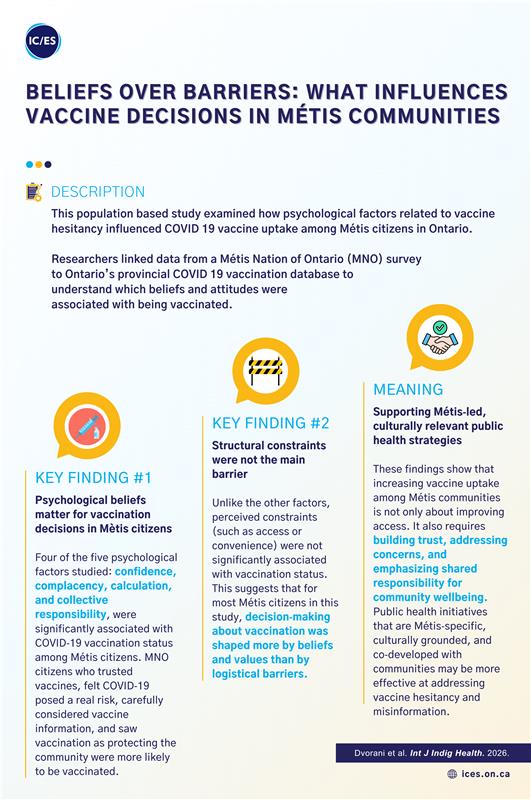
Background — The COVID-19 pandemic exacerbated existing inequalities and vulnerabilities among marginalized groups, particularly Indigenous Peoples in Canada. We assessed the influence of psychological antecedents of vaccine hesitancy on COVID-19 vaccine uptake among Métis in Ontario, Canada.
Methods — The Métis Nation of Ontario (MNO) survey, a population-based online survey, was used to capture MNO citizens’ “5Cs” of psychological antecedents relating to vaccination intention (Confidence, Complacency, Constraint, Calculation, Collective Responsibility). Descriptive statistics and multivariable logistic regression models were used to model vaccination status to assess the influence of psychological antecedents of vaccination with vaccination behaviour, by linking survey data to the Ontario COVID-19 Vaccine Database (COVaxON), which captures all COVID-19 vaccinations administered in Ontario.
Results — The study cohort size was 3,999, with 3,701 (92.5%) MNO citizens participating partially or fully vaccinated. Results from five separate logistic regression models suggested four variables/indicators from 5Cs – Confidence, Complacency, Calculation, and Collective Responsibility – were significantly associated with vaccination status, while Constraints was not.
Conclusions — This study contributes valuable insight on the factors that may influence the decision to opt out of receiving a COVID-19 vaccination among Métis and can inform the development of targeted public health interventions and educational strategies aimed at dispelling misconceptions about vaccination.
Dvorani E, Edwards A, Kim E, Khan H, Chaurasia A, Kwong JC, Cripps S, King KD, Mecredy G, Cooke M. Int J Indig Health. 2026; 21(1).
The ICES website uses cookies. If that’s okay with you, keep on browsing, or learn more about our Privacy Policy.