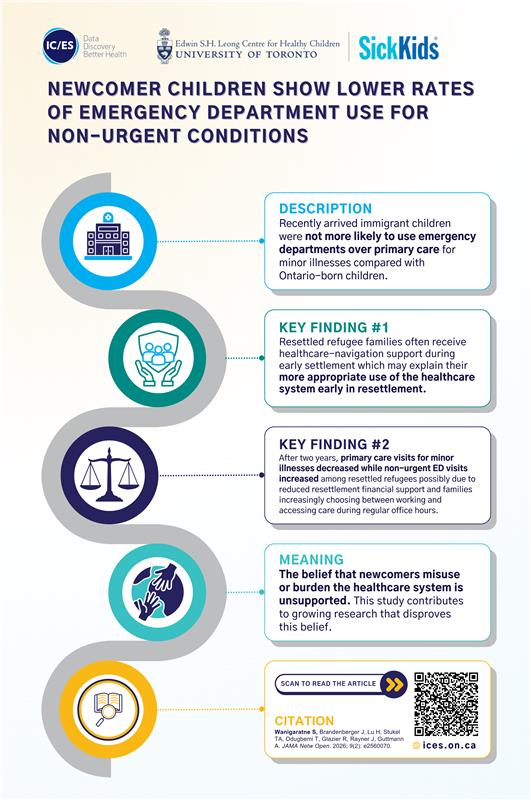
Newcomer children show lower rates of emergency department use for non‑urgent conditions, study finds
Refugee and immigrant children are less likely to visit the emergency department for minor illnesses compared to children born in Ontario.
Importance — Health care resource constraints across North America are leading to decreased access to primary care, particularly for newcomers. In Canada, several pathways to permanent residency shape early navigation to the publicly funded health care system.
Objective — To explore access to primary care by analyzing the percentage of all minor illness visits seen in an emergency department (ED) in recently arrived refugee and immigrant children compared with their Ontario-born peers.
Design, setting, and participants — This population-based cohort study took place in Ontario, Canada, and included immigrant children who arrived between 2008 and 2017 and Ontario-born children. Participants were aged 0 to 14 years and followed for 4 years after index date (ie, 1 year after health care eligibility). Data were analyzed between November 2023 and December 2025.
Exposure — Government-assisted refugees (GARs), privately sponsored refugees (PSRs), successful asylum-seekers (referred to as protected persons [PPs] in Canada), nonrefugee immigrant (NRIs), each matched 1:4 to Ontario-born children by age, sex, and urban area.
Main outcomes and measures — The percentage of minor illness ED visits (ie, primary care plus ED visits for equivalent reasons) in the first and second 2-year periods after eligibility was calculated for each child with at least 1 minor illness visit. The difference in mean percentage was modeled using linear regression and compared each immigrant group to Ontario-born children adjusting for morbidity, material resources resources quintile, and primary care affiliation.
Results — Overall, 458,597 children were included (mean [SD] age, 8.0 [4.3] years; 221 237 females [48%]; 237 360 males [52%]; GARs, 10 211 [2.23%]; PSRs, 7810 [1.70%]; PPs, 11 540 [2.52%]; NRIs, 83 537 [18.22%]; and Ontario-born matches, 345 499 [75.34%]). In the first 2 years, immigrant groups had significantly lower adjusted differences in the mean percentage of minor illnesses seen in the ED compared with their Ontario-born matches (GARs: -5.11% [95% CI, -5.63% to -4.57%]; PSRs: -5.24% [95% CI, -5.80% to -4.67%]; PPs: -3.37% [95% CI, -3.86% to -2.87%]; NRIs: -4.24% [95% CI, -4.40% to -4.09%]. In the second 2 years, differences were attenuated but remained significantly lower.
Conclusions and relevance — In this cohort study, refugee and nonrefugee immigrant children in their early resettlement period were less likely to use the ED than Ontario-born children for minor illnesses, suggesting adequate access to primary care.
Wanigaratne S, Brandenberger J, Lu H, Stukel TA, Odugbemi T, Glazier R, Rayner J, Guttmann A. JAMA Netw Open. 2026; 9(2): e2560070.
The ICES website uses cookies. If that’s okay with you, keep on browsing, or learn more about our Privacy Policy.