Go to content

Incidence of psychotic disorders by birth cohort: a population-based cohort study in Ontario, Canada

Share

Background — Previous reports have suggested that the incidence of psychotic disorders has either been stable or decreasing over time in high-income countries, but overall trends may not capture birth cohort differences influenced by varying exposures to risk factors. We sought to assess whether the incidence of psychotic disorders has changed across birth cohorts.

Methods — We conducted a retrospective cohort study using linked health administrative data on all people born between 1960 and 2009 in Ontario, Canada. We identified diagnoses of schizophrenia spectrum disorder (SSD) and psychosis not otherwise specified (NOS) — collectively, psychotic disorders — between 1992 and 2023 and compared changes in incidence (diagnosis with no prior diagnosis in the previous 5 yr), cumulative incidence, and prevalence across birth cohorts in 5-year increments. We used age–period–cohort (APC) models to compare birth cohort effects, accounting for differences in age and period.

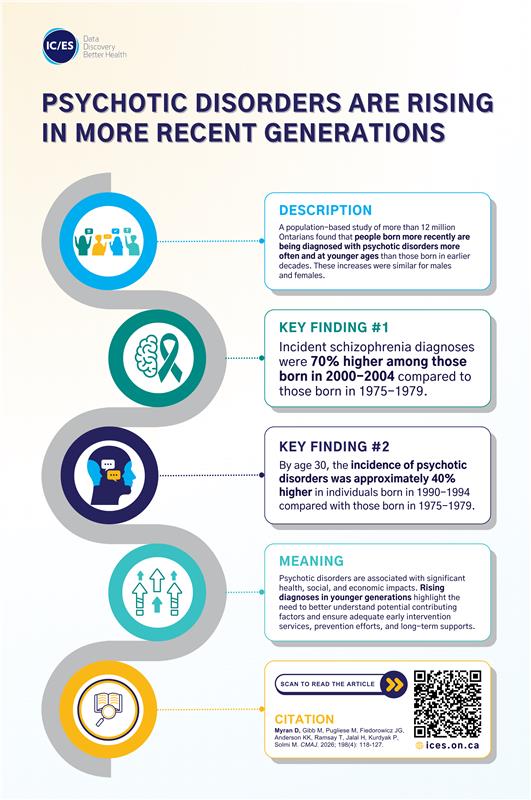
Results — We included 12,231,314 people, of whom 15,2587 (0.9%) were diagnosed with a psychotic disorder during the study period. Between 1997 and 2023, the annual incidence of psychotic disorders increased by 60% among people aged 14 to 20 years and was stable or declined among those aged 21 to 50 years. We observed birth cohort increases in the incidence of psychotic disorders and decreases in the age of diagnosis. The APC models indicated that the incidence of schizophrenia was 70% (incidence rate ratio [IRR] 1.70, 95% confidence interval [CI] 1.63 to 1.78) higher among those born in 2000 to 2004 compared with those born in 1975 to 1979, with increases in psychosis NOS (IRR 2.89, 95% CI 2.73 to 3.06) across birth cohorts being greater than those in SSD (IRR 1.32, 95% CI 1.25 to 1.40). Compared with those born in 1975 to 1979, the percentage of people who had been diagnosed with a psychotic disorder at age 20 years was 104% higher (0.55% v. 0.27%) for those born in 2000 to 2004, and 37.5% higher (1.32% v. 0.96%) at age 30 years for those born in 1990 to 1994. Birth cohort effects were comparable among males and females, and we observed the same results in sensitivity analyses examining diagnoses in outpatient settings only or in hospital settings only.

Interpretation — The incidence of psychotic disorders has increased in more recent birth cohorts. Although some of the findings may reflect improved access to assessment and treatment, further research is needed to examine potential contributors. These results can inform early psychosis intervention services in Canada

Information

Citation

Myran DT, Gibb M, Pugliese M, Fiedorowicz JG, Anderson KK, Ramsay T, Jalal H, Kurdyak P, Solmi M. CMAJ. 2026; 198(4): E118-E127.

View Source

Associated Sites